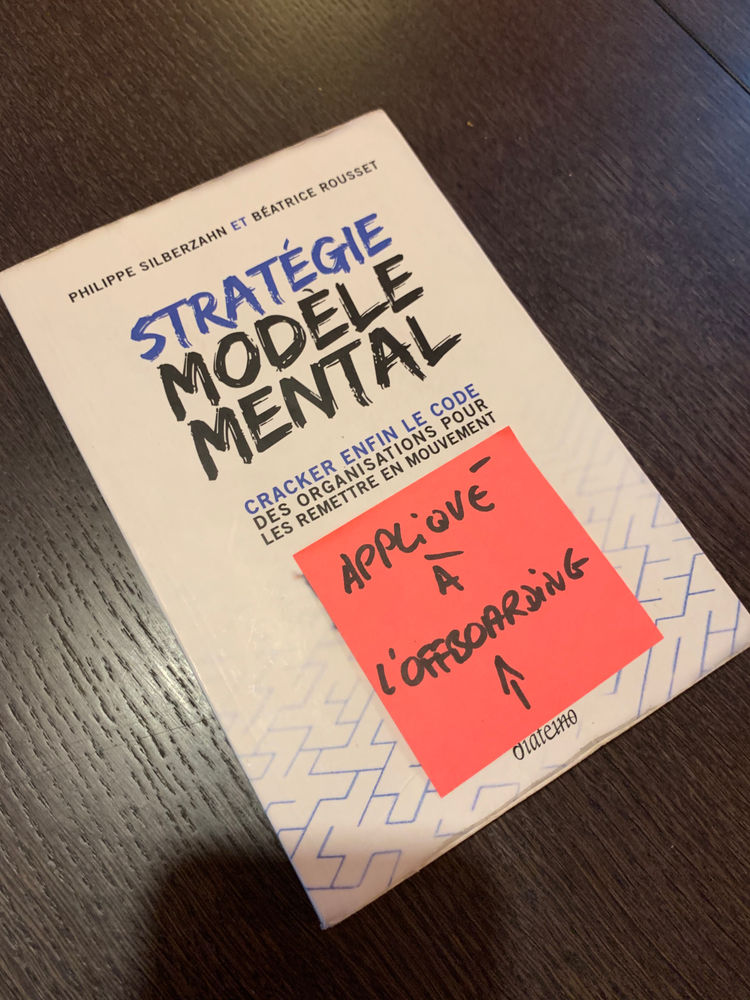

After reading this book co-written by Philippe Silberzahn & Béatrice Rousset, both professors (especially at EM Lyon ☺️ #nostalgie) & speakers, I found the interesting parallel between two of their ideas and their application to offboarding in business.
Applied to offboarding or to the reasoning of employees before deciding to leave a company, this is what this could give.
In the past, the very idea of leaving a company was uncomfortable for the employee, so talking about it with your manager without imagining a boomerang coming back during the next evaluation (annual necessarily, no more regular feedback than that) could seem unthinkable. The employee was terrified when his decision was made to resign, then 3 months of notice followed during which the employee was either exploited to the maximum until the minute before leaving, or “persona non grata” in the company (“He decided to leave the family, you have to make him understand what he has to lose, right?“. In short, the best way To make the marriage last, for the employee and the employer, were from Hide all couple discussions under the carpet.
In today's world, opportunities between an employee and his manager to discuss the aspirations of the former are regular, and sometimes even at the initiative of the latter! This may seem suicidal or masochistic, but it is the behavior adapted to an inescapable end. In 2020, the aspiration of an employee to “take on a new challenge” in another company, after 24 months in office, should no longer surprise a manager. Obviously, this figure changes according to sectors of activity, functions and seniorities, but the ability that managers will have to identify, among their employees, the ratio of “80/20" whose future at 12 months is “very likely in the company/elsewhere” will be a valuable management input. In this way, the manager limits the risk of surprise and anticipates movements within his team, he adapts his individual coaching to improve the performance of the team, and therefore that of the company.
In business, many employee behaviors are dictated by mimicry, and imitated behaviors are the result of a specific professional environment, of the DNA specific to each organization. It is now common to talk about the DNA of companies, which is difficult to describe in any other way than the authors P. Silberzahn & B. Rousset do:”individual and collective assumptions, values, and beliefs“. This DNA gives rise to behaviors and habits within the company, so these”filter glasses“that each employee wears. With each new occurrence, the “frame of reference” is strengthened a little more and the difficulty for the employee to get rid of this pair of glasses increases.
In this regard, Offboarding is no exception. If there is one area where the employee is most often content to mimic what he has seen, it is the management of his end of cycle/transmission. If he noticed that his former colleagues, after submitting their resignations, arrived later and left the office earlier, he will do the same (no case of resigners arriving earlier identified). If he noticed that as a handover, they were organizing a departure party and writing an email with “the hot deadlines” to be brought to the attention of the manager, he will do the same. No more and no less. The particularity of offboarding is that the employee already has his head elsewhere during his notice.. Even without bad will, few employees will rack their brains to simplify the task of their manager/successor after they leave. However, these habits are only “filtering glasses”, which everyone can decide to remove according to their motivations : leaving with the feeling of work done, seeking recognition from your manager, getting a bonus, etc.
Conclusion : in the Linkedin era, the ability to imitate is counterproductive and that of self-criticism by the collaborator, or initiative, has become a standard. In the age of Linkedin, The departure of an employee is no longer a remarkable event, it can even be done with the most total indifference. On the other hand, It is up to the collaborator (and to the company that promotes it) to make offboarding a remarkable and value-creating period.
Komin.io has two main reasons for being. The 1st is theIntensification of turnover in companies, inevitable by 2030, which will penalize companies that have not changed their offboarding/onboarding approach. The 2nd is the lack of training and motivation for managers to manage the end of the employee cycle in the company. It's human, we prefer to invest time on the people we know will stay. Komin.io supports its customers in the transfer of knowledge between 2 employees succeeding each other in the same position. Offboarding is (re) invented, turnover is de-dramatized.
“With Komin, we documented our operating procedures 10x faster than with paper”
- J. Cerruti (Methods & Industrialization Manager)


