

In private life, we often say we realize how much we care about people when they are no longer around. It's quite similar in the pro sphere at the time of offboarding.
Take the example of Nicolas, Product Owner for 2.5 years in a company. During these almost 3 years, he and his manager talked about his future: during the 1to1 weekly, quarterly performance reviews and other less formal exchanges. His manager knows Nicolas's long-term aspirations, he also knows that he is not necessarily able to bring him what he wants in the medium term within the company. In short, he knows that Nicolas is not eternal, but he prefers not to dramatize and say to himself”So far so good. So far, everything is fine,...“(cf. La Haine 📽👌). One morning, Nicolas gives him his resignation., and informs him of his wish to shorten the duration of his notice (like 95% of resigning employees).

From that moment on, and in the 24h-48h that will follow, The manager becomes aware of some offboarding issues and goes through a succession of states.

First of all, The panic. That of not knowing What will he do to achieve the goals quarterly/semi-annual/annual (about which he was quite optimistic 😳), that of not knowing how or how long it will take to recruit a new Product Owner, then that of the training “of the new” (which will “necessarily take 6 months to be operational”).
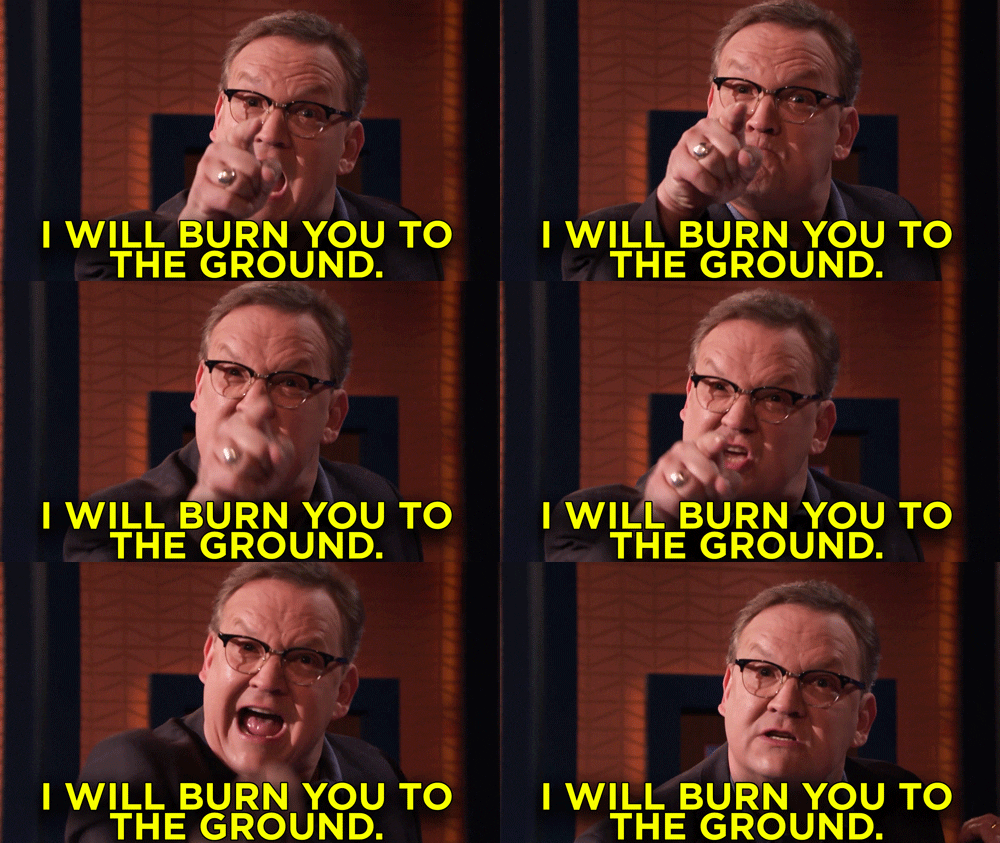
Then maybe the wrath. He is angry to realize that “sound” Product Owner prefers to work elsewhere than alongside him, a feeling like an injury, which combines misunderstanding and resentment. Sometimes, he is also angry at the company, which does not allow him to keep his Talents.
Finally, after sleeping, the manager made up his mind about Nicolas's resignation, which is inevitable. After all, he has heard enough times that”Nobody is irreplaceable“, no? That's it, He gets into action. At this moment, he is wondering how he will be able to limit the risk of a “shortfall” in the business when Nicolas's successor takes over his job (with +/- 6 months of skills development), by doing as well as Nicolas did, by necessarily bringing his own touch. In short, he is thinking about the handover.
After starting the recruitment process, the manager wonders what Nicolas should “leave behind” before leaving. He discusses with Nicolas about his missions and recurring tasks, interactions with the rest of the team and interdependencies (😰) etc. In fact, by preparing for the offboarding and onboarding of his successor, The manager understands Nicolas's role much better, his expertise and the difficulty he will have in instilling the good practices/added values of the Futur-ex-Product-Owner in his replacement.
This is only one example, however turnover is inevitable in companies, in yours as well as at Komin. Sometimes turnover is even a good thing. It is therefore better to be prepared for it, there is nothing dramatic if its consequences are anticipated.
It's a strange paradigm in Management/Business: we only really care about what employees know how to do when they want to leave us 🤔
At Komin.io, we decided to reduce this paradigm to smithereens. Are we going together?
“With Komin, we documented our operating procedures 10x faster than with paper”
- J. Cerruti (Methods & Industrialization Manager)


