

The idea for what would become Komin.io was born when I was trainee in a Large Group. I have always paid a lot of attention to observation of people and the practices in place in their work environment. Quickly after my arrival (and an informal onboarding of a few days late), I understood that I was the 497th intern to occupy this position (with +/- 5% error), whose turnover was wonderfully orchestrated every 6 months by the HR department. With managers who stayed in place, I asked myself Why was the end of the cycle of the “outgoing” intern and the beginning of the “incoming” intern not better organized, in my opinion, seriously penalizing the operational performance of the team.
After this experience and a few others as part of my business studies, I started my career in consulting. I did this job for 7 years, while simultaneously having an entrepreneurial experience, a brilliant break with Arthur & Arnaud, who changed my vision of the world of work. But that's not the point. As a consultant, I have worked with several dozen clients, large listed groups, ETIs or SMEs. As I grew older and continued to observe my clients' management practices, I confirmed my observation on the total absence of preparation for the beginning and end of the cycle of employees of a company, whether it is a permanent contract, a fixed-term contract or even an internship.
3 years ago, by taking an operational job as MD/COO at ScientiFeet, I was able to implement the solutions I had imagined as a consultant. With regard to the transfer of knowledge, the whole difficulty lies in the systematization of this handover process.. It is obvious that the departure of a Sales Heavyweight or Product Owner presents a high risk on the sustainability of any company's business. Despite this observation, this initial phase is quite rarely well supervised and organized, with managers finding themselves drawn into immediate operational problems. And I'm not even talking about the other positions affected by departures and whose stakes seem a little less important.
In January 2019, in agreement with the management of Prodways/ScientiFeet, I decided that it was time for me to take this damn bull by the horns, and to propose a solution to this problem which regularly concerns (almost) all operational staff in companies around the world. I had identified a “pain point” + the recurring nature of this “pain point” + an obviously large number of companies concerned → that was enough to get me to work.
Before leaving ScientiFeet in June 2019, I had time to develop the idea of Komin.io, in particular by reading a lot of books on leadership, personal development, entrepreneurship... An obviously common practice, probably reassuring for aspiring business creators like me who want to prepare for the long endurance race that is the entrepreneurial process. Among these books (Shoe Dog/The Art of Victory by Phil Knight the founder of Nike, The Happiness Company by Tony Hsieh the founder of Zappos, From 0 to 1 by Peter Thiel, the founder of Paypal,...), one of the most remarkable must be Start With Why by Simon Sinek, a British author/speaker on the topics of management and motivation in companies (cf. TEDx)
This work is well known. Some will say that its main messages make sense, but I found that they allow you to gain perspective on what you are working on and to ask yourself very structuring questions for the future of a business.
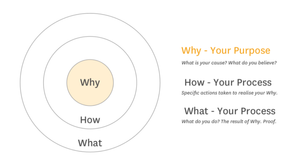
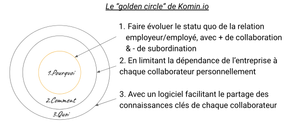
During the last months of my reflection leading to the creation of Komin, I asked myself the question of what are WHY, HOW and WHAT of “my business” (by the way I am looking to “share” it with other founders (CTO, CSO, CPO), if you know someone who knows someone who... 📞!!).
The observation behind Komin is the combination of two elements: greater volatility of Talents, which results in a shorter average length of employment year after year in France, but also the difficulty for managers to carry out the “last-mile management act”(copyright Komin:)), which consists in anticipating and organizing the departure of an employee. As a result, companies are seeing the volume of staff entrances/exits increase, without however having a clear and systematic protocol to calmly manage a departure, nor to effectively organize the skills development of a newcomer.
The observation of companies and management models that I carried out for 10 years in France allowed me to see how much The new generations (Y and Z especially, X to a lesser extent) require companies employing them(regardless of size) to change their management methods. This evolution, experienced by the majority of large companies, responds to a strong desire for these generations: a search for meaning in their job (vs choosing a “food” job), autonomy (vs micro-management), involvement (vs execution), among others... These behaviors are not isolated and do not concern a fringe of 16-25 year olds, it is 80% of them who want to work in an environment that offers them these advantages, whether they have graduated from the best institutions or not!
In France, an essential element of an employment contract is the “relationship of subordination” between an employee and his employer. This condition, without being exclusive to constitute proof of the existence of an employment contract (+ existence of work + remuneration), can be applied more or less strictly, depending on the personal management model of each employer/manager.
I am convinced that to Work better TOMORROW with generations Y or Z, or maybe I should write collaborating instead of working, employers have an interest in reevaluating their interpretation of the relationship of subordination between them and their employees.
Tomorrow, to get the best out of Talents, it will be necessary offer a “New Deal” to our employees, the Company will have to develop new management and collaboration methods. This “New Deal” could be a global management model, characterized by a greater search for collaboration between employer and employee, and less attention to subordination. If I had to illustrate my point:
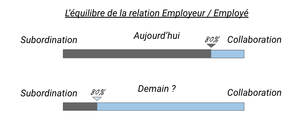
The strong desires for involvement, autonomy or the search for meaning of the youngest generations are not incompatible with the existence of a relationship of subordination.. Don't get me wrong, this vision does not exclude subordination or control, of course. It's not about trusting your employees blindly. Management will still be necessary, but in a less “top-down” and more “flat” version, a trend already initiated in the most recent structures.
Another version of the WHY by Komin could be: review the status quo of the traditional employment contract, make companies and their employees partners. This means that they will have to recruit and develop “partners” within the organization, and no longer “subordinates.” They will have to evolve an employer/employee relationship that is still too often traditional, locking new generations into a position of execution that they reject en masse.
You have to be realistic: today's 16—25/30 year olds will not spend more than 2 years in office on average, that leaves 2 options for businesses :
And you, what do you think of the WHY of Komin and the future of the employment contract in France 🤔, are we shaking up the STATUS QUO together?
“With Komin, we documented our operating procedures 10x faster than with paper”
- J. Cerruti (Methods & Industrialization Manager)


